Here is exactly what the FBI took in Fulton County
American Doom was the only media outlet to insist on the release of records that show what the FBI took last month.
This is a developing and fast-moving story that American Doom has been fighting in court over for weeks. Please check back later for updates. This tedious and time-consuming work is not possible without your support. Please choose a paid subscription or consider a one-time contribution to support American Doom’s aggressive, fact-based journalism. - jg
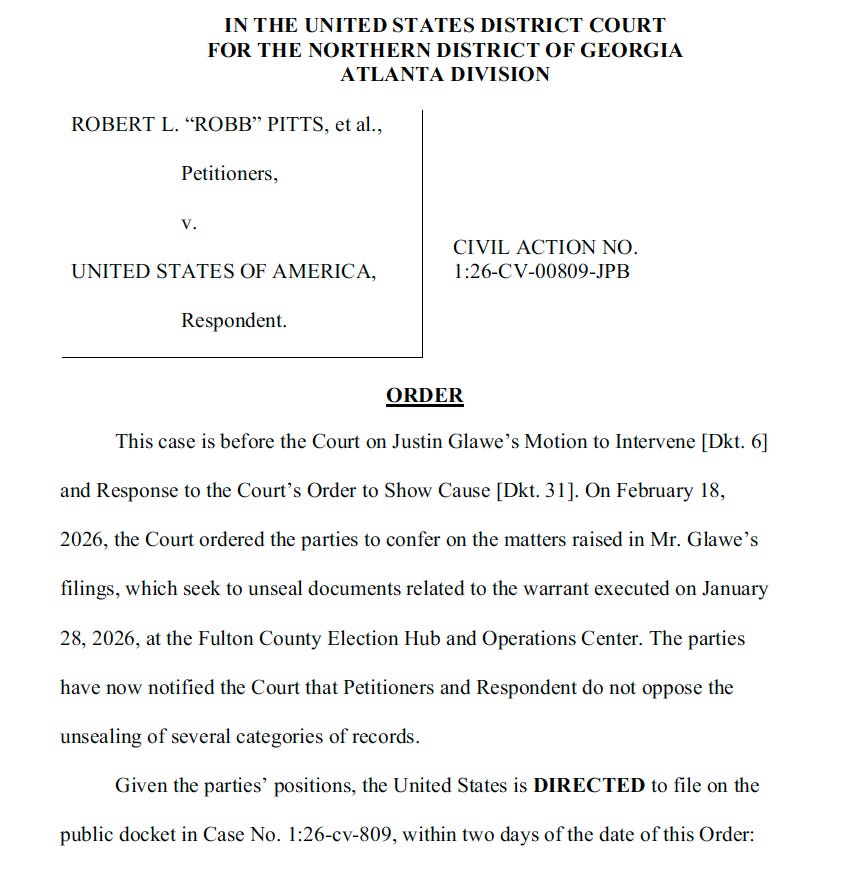
A federal judge in Atlanta has decided in American Doom’s favor and has ordered the Justice Department to release documents related to the Jan. 28 FBI raid on a Fulton County elections warehouse. You can read the full order below.
For weeks, our attorneys have been fighting in court to have these documents unsealed after American Doom filed a motion to intervene in the case, which pits Fulton County officials against President Donald Trump’s Justice Department. After other media outlets pulled out of the case, American Doom pressed on, resulting in the release of documents on Wednesday that show precisely what the FBI took on Jan. 28.
The Justice Department opposed releasing these records, noting in a Tuesday court filing that “numerous major media outlets” had withdrawn their motions to unseal records after the affidavit that led to the FBI raid was unsealed by the court.
“One putative intervenor remains,” Associate Attorney General Stanley E. Woodward Jr. wrote in the filing. “Justin Glawe contends his motion is not moot and asks that several additional categories of materials be unsealed.”
Those materials were unsealed on Wednesday. Also on Wednesday, Trump’s Justice Department continued its efforts to halt an evidentiary hearing scheduled for Friday. Arguing for extraordinarily broad powers, the DOJ effectively argued that U.S. states and counties have no Fourth Amendment rights, and that the federal government can seize whatever records — election-related or otherwise — whenever and wherever it wants.
At no time in American history has the federal government seized election records and lists of voters from county and state authorities, which is precisely what happened on Jan. 28. Despite the historic nature of these actions, the Justice Department asked a federal magistrate judge to shield documents that led to the raid from the public. That request was released, thanks to Wednesday’s ruling by U.S. District Judge J.P. Boulee.
In the request, the DOJ argued that allowing the public to see the affidavit would “seriously jeopardize [the- investigation, including by giving targets an opportunity to destroy or tamper with evidence, change patterns of behavior, notify confederates, and flee from prosecution.”
Having read the affidavit, magistrate judge Catherine Salinas then approved the government’s request to seal the document, and issued the search warrant that allowed the FBI to seize election records. After conducting its raid, FBI agents reported back to Salinas, detailing the materials its agents seized. This document was also released as a result of American Doom’s motion to intervene in the case.
The document shows that the FBI seized 653 boxes of material from the Fulton County elections warehouse. It’s not clear why this number is different from the 656 boxes that were seized, which has been reported widely by multiple media outlets and been scrutinized by Trump-supporting members of the Georgia State Election Board.
Those board members alleged last week that roughly 50 boxes of material are missing, but the records released on Wednesday show no mention of a total of 700 boxes. Nor does the document above — called a “search warrant return” — make mention of any efforts by Fulton County officials to hide or withhold boxes of material from the 2020 election from FBI agents present on the day of the raid.
The affidavit that led to the raid has come under intense scrutiny after it was released, revealing that the claims made by the author of the document, FBI Special Agent Hugh Evans, were based entirely on disproven fraud claims that had already been investigated by various authorities.
The affidavit’s claims stem from apparent coordination between Kurt Olsen, who partook in Trump administration efforts to overturn the 2020 election and has been reprimanded by courts for providing false statements, and a small group of election denial activists whose biases on behalf of the president as well as the factually inaccurate nature of many of their claims raise questions about the seriousness of the Justice Department’s investigation into supposed wrongdoing.
All of this comes as the Justice Department has tried to avoid an evidentiary hearing on Friday in which Evans is scheduled to testify. The DOJ has argued that Evans’ testimony is not necessary, and could impact what the government says is an ongoing criminal investigation.
“The investigation is in its early stages, and there is a possible future trial,” Justice Department attorneys wrote in a Feb. 20 filing.
In response, Fulton County argued that Evans’ affidavit contained “reckless disregard of the truth,” and was “misleading and riddled with material omissions” that, if included, would not have resulted in a judge issuing the search warrant that led to the Jan. 28 raid.
Central to this entire case is whether the claims made in the affidavit — which amount to technical errors like double-counting ballots made by poll workers during the 2020 election — were done intentionally. Evans’ entire argument that the Justice Department should be able to review the records it seized is based on a major if. As in, if these errors were done willfully, it would be evidence of a crime.
Fulton County claims that, under Evans’ “novel theory of probable cause, the DOJ could seize any record, no matter how unfounded the claim of violation, so long as the records would be evidence of a crime if someone had the intent to use them in a criminal scheme.”
There is no evidence that any of the many errors that occurred during the 2020 election were committed intentionally.
But the Justice Department — backed by the conspiratorial “research” of Olsen and a small but vocal group of Trump-supporting activists — has pressed on nonetheless. In doing so, Fulton County warns that a dangerous precedent is being set. That precedent would allow Trump’s DOJ to seize election and voting records in the wake of November’s midterms, throwing the results of the election into question and maybe even overturning results in favor of Republicans.
***
Please follow AD on our social media for a little more doom to scroll. That’s what we all need, right?
Bluesky - @americandoom.bsky.social
TikTok - @americandoom_
YouTube - @americandoom_
Instagram - @americandoom_
X - @americandoom_


