


We’re heading into the fall, which means efforts to interfere with and overturn the results of the November midterms are ramping up. American Doom is on top of these efforts in Georgia and elsewhere. To support our work, please consider becoming a paid subscriber or drop a few bucks into our Coffee Fund. Now, on to the news… - jg
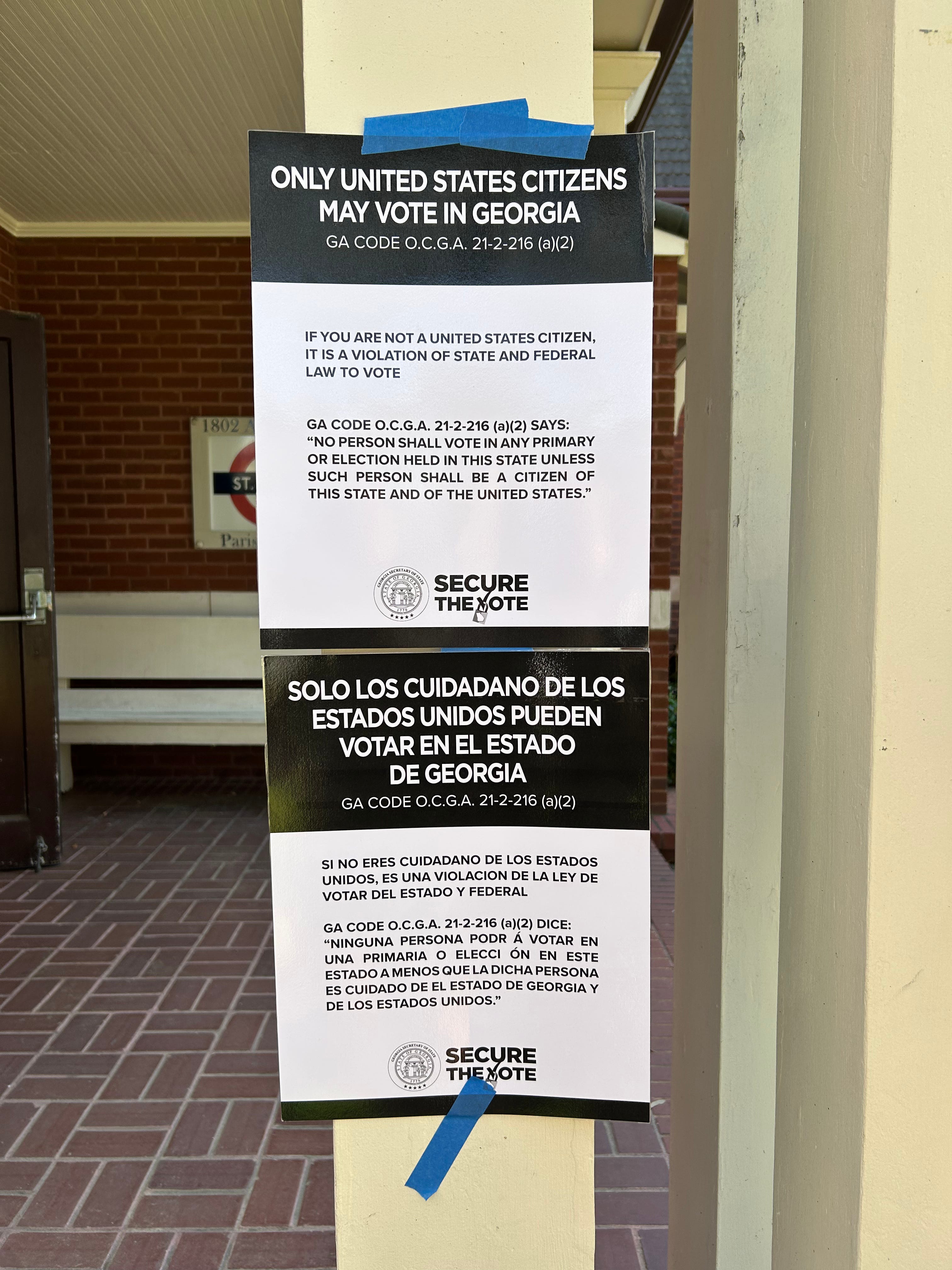
It takes a lot of reading between the lines to fully understand the threats to elections and other anti-democratic behavior by Trump and Republicans. Much of what they do is obvious for a simple reason: they need credit from the election denial movement (which is indistinguishable from the MAGA base) for saying that elections are rigged and that people like Trump are doing something about it. Hence the SAVE Act, the seizure of ballots in Georgia, executive orders, Trump’s primetime speech, withholding of federal funds to force election rule changes, threats to arrest election officials, and on and on.

But a careful examination of these statements and actions is required in order to try to anticipate what’s coming next, and how it could impact Americans’ right to choose their own leaders. This guess work is at the center of a lawsuit filed by the Democratic National Committee last week that seeks to further expose the Trump administration’s plans to interfere in the midterms.
On Aug. 20, the DNC filed a fairly routine lawsuit alleging that the Justice Department and Homeland Security violated the Freedom of Information Act by not responding to requests for records about plans to seize ballots and other election materials in November. (Federal agencies often fail to comply with the statutory deadlines of FOIA, and suing those agencies in order to get records is a common way to force their hand.)
While holding the Trump administration accountable for not complying with FOIA is the important, technical reason for the lawsuit, its context is perhaps even more important. The lawsuit is the DNC saying, We think you’re going to seize ballots, so show us in court why and how you’re actually not going to do this. In other words, the DNC is saying it is reasonably foreseeable that Trump will seize ballots and other materials under the guise of a national emergency, to be declared at some point between now and November, as has long been expected by election observers and demanded by the election denial movement.
In its lawsuit, the DNC noted that Trump’s Justice Department has been threatening to arrest election officials in all 50 states if they allow ineligible voters to cast ballots in November. The threat comes under the overblown and outright false claims of widespread voting by noncitizens.
“These preemptive threats suggest that federal law enforcement may have already opened initial assessments, laying the groundwork for potential seizures of election materials prior to certification of the 2026 midterm election,” the lawsuit states.
The DNC also notes that the Justice Department has taken down guidance that stresses “non-interference” in ongoing elections — even if there is evidence of fraud — by federal law enforcement.
Threats to arrest election officials and the removal of the “non-interference” guidance are clues, according to the DNC lawsuit, that the Trump administration plans to seize ballots in November.
We’re already in uncharted territory
Of course, federal law enforcement seizing ballots is not supposed to happen — and in fact prior to January, when the FBI raided a Fulton County elections warehouse, the seizure of ballots by the federal government from local authorities had not occurred in all of American history. (I’ve scoured articles and spoken to many legal experts to confirm this fact, which is also noted in this important Loyola Law School article from former Justice Department election lawyers Justin Levitt and John Keller.) Federal law enforcement shouldn’t be seizing ballots because the Justice Department is an extension of the executive branch, which has no constitutional role in administering elections.

The DOJ does, however, have a role in enforcing election law. That’s why we saw the raid in January: under the theory that election rules and laws had been violated during the 2020 election, an FBI agent in Atlanta applied for a search warrant from a magistrate judge. The judge approved the warrant even though it was based on exaggerated or outright false claims of fraud perpetuated by a variety of pro-Trump election denial activists, including three public officials in Georgia. American Doom filed a motion in court demanding that the DOJ reveal the names of some of the witnesses relied upon for the FBI agent’s affidavit, and won.
The judge probably shouldn’t have approved the warrant — it was based on claims of fraud that had already been investigated and largely dismissed by state authorities — but did so anyway, in part because judges are taught to have a “presumption of regularity” when considering requests from the Justice Department. This “presumption of regularity” means that judges are to assume that the Justice Department is acting in good faith, and has a good reason to be asking for whatever it’s asking for. Under the Trump administration, this quasi-legal precedent can no longer be relied upon, as has been well documented, particularly in relation to ICE tactics.
The judge in Georgia also would have considered the harm that seizing ballots from an election that had occurred more than five years ago would do to the local governments — Fulton County and the State of Georgia — that were the targets of the investigation. Considering that the ballots were from the 2020 election and not one that was occurring in 2026, the judge appears to have decided that seizing the ballots would not do significant harm to the ability of Fulton County and Georgia to carry out an election that had already occurred, as Levitt and Keller note.
But judges being asked by the Justice Department in November for search warrants to seize ballots in an ongoing election is an entirely different matter, Levitt and Keller point out. Theoretically, those judges should immediately deny these requests — seizing ballots in an election that has just occurred and has yet to be legally certified would directly interfere with an election process in which the executive branch has no role under the constitution.
Whether the Justice Department attempts to seize ballots is question number one. Question number two is whether judges will allow the Justice Department or other federal law enforcement to do so.
A ‘national emergency’ to seize ballots
Clearly, the DNC believes it is likely that the Trump administration will attempt to seize ballots in November. If magistrate judges refuse to sign off on warrants for ballots and other election materials, the DNC anticipates that DOJ lawyers will try to go around those refusals by asking federal district court judges to approve the warrants, likely under the guise of some sort of national emergency.
The DNC anticipates this action because it has already occurred.
In January, as ICE agents swarmed Minneapolis, causing chaos, arresting thousands, and killing Alex Pretti and Renee Good, protesters took to the streets. In one infamous incident, former CNN anchor Don Lemon and independent journalist Georgia Fort accompanied protesters who entered a church led by a pastor who was also an ICE official. The Justice Department arrested Lemon and Fort along with two dozen protesters, charging them with various crimes.

But before agents could arrest some of those involved with the protest at the church, they had to obtain warrants for some of those arrests. Early in the case, a magistrate judge approved warrants for three people sought in connection with the event, but denied warrants for five others. The Justice Department then asked for a district judge to review the magistrate judge’s denial of the five warrants — a situation that, according to one judge in the Eighth District, had never occurred.
“I have surveyed all of our judges — some of whom have been judges in our District for over 40 years — and no one can remember the government asking a district judge to review a magistrate judge’s denial of an arrest warrant,” wrote Chief Judge Patrick Schiltz, who was appointed by George W. Bush and clerked for former conservative judicial icon and Supreme Court Justice Antonin Scalia. “The reason why this never happens is likely that, if the government does not like the magistrate judge’s decision, it can either improve the affidavit and present it again to the same magistrate judge or it can present its case to a grand jury and seek an indictment.”
Instead, the Justice Department appears to have believed it could simply get around the magistrate judge’s refusal to issue warrants by having a district judge sign off on the warrants under the guise of a “national emergency,” according to Schiltz.
The Justice Department argued that, if the five warrants weren’t issued, “copycats” would invade other churches as part of growing protests in the Twin Cities at the time.
“Apparently, the government believes that the arrests of the leaders of the Cities Church invasion — whose arrests have received widespread international attention — will not deter copycats, but arresting five additional suspects will,” Schiltz wrote in a January 23, 2026 letter to a judge at the Eight Circuit Court of Appeals. “The government has also argued that I must accept this as true because they said it, and they are the government.”
The Justice Department claimed that there was a “national-security emergency” that required Schiltz to reconsider the magistrate judge’s refusal to sign off on warrants for five protesters. Schiltz dismissed this claim from the DOJ as “frivolous.”
Justice Department lawyers will likely attempt to obtain search warrants for ballots and other election materials in November. Hopefully, the judges determining whether to issue the warrants will be up to speed on the case in Fulton County, as well as the DOJ’s questionable seizures of materials and investigations in at least five other locations across the country.
If magistrate judges refuse to issue warrants, the Justice Department will try to appeal to judges like Schiltz. Regardless, if any judge issues warrants for ballots and allows the Trump administration to seize them before results are certified, we’ll be — once again — in a full-blown constitutional crisis.
By seizing ballots before certification of results, the Trump administration can effectively kneecap Democrats’ chances of winning the House of Representatives and the Senate. Trump’s DOJ won’t seize ballots from Republican strongholds; instead, they’ll take ballots from places like Fulton County, where large swaths of Black voters largely cast ballots for Democrats.
Then, we’ll truly be in banana republic territory. In those less-free parts of the world, elections aren’t decided by how people vote, but on the people controlling what votes are counted — and how.
***
Follow American Doom on social:
Bluesky - @americandoom.bsky.social
TikTok - @americandoom_
YouTube - @americandoom_
Instagram - @americandoom_
X - @americandoom_
Great article, and insight.