


Justin here. Chloe’s got a comprehensive rundown of everything Iran. Bottom line: it’s not getting any better and Trump isn’t helping — when he’s paying attention at all. If you want to support our work staying on top of all the madness, choose a paid subscription or throw a few dollars our way at the Doom Coffee Fund. Now, on to the news… - jg
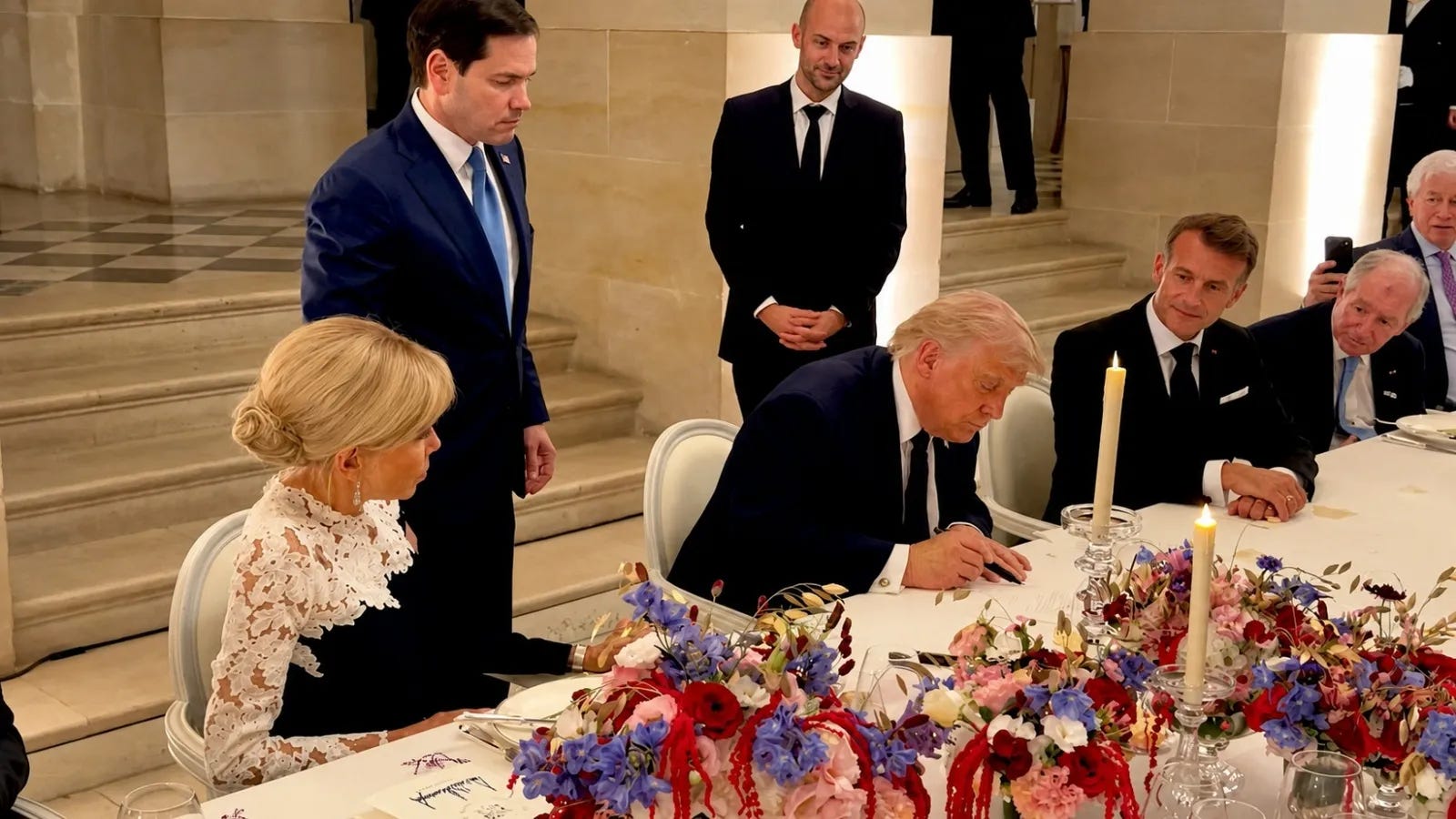
It took less than two weeks for President Donald Trump’s “peace agreement” with Iran to fall apart. Israel, Iran and the United States have all re-engaged in military operations that were prohibited by the memorandum of understanding that Trump signed at Versailles on June 17.
Now, the situation is in free fall, with Trump appearing to threaten on Saturday evening to attack Iran with nuclear weapons. In a Saturday evening post on Truth Social, Trump blamed Iran for violating the cease fire agreement that was put in place at Versailles.
“There may come a point when we are no longer able to be reasonable, and will be forced to militarily complete the job that we very successfully started,” Trump said. “If that happens, the Islamic Republic of Iran will no longer exist!”
This is the second time Trump has made threats about the complete destruction of Iran. In April, Trump claimed that “a whole civilization will die tonight.” In response to U.S. attacks, Iran on Sunday fired on Bahrain and Kuwait and threatened to end peace talks if the Trump administration doesn’t stand down.

Before the agreement was signed at Versailles, Prime Minister Benjamin Netanyahu declared that Israel would not leave Lebanon, but would halt strikes if Hezbollah also abided by the ceasefire agreement. Strikes continued through the announcement of the peace deal, and one day later, 47 people were killed in Lebanon following a series of strikes from the Israel Defence Force (IDF).
On June 20, a dispute arose between Iran and the U.S. over whether Tehran had agreed to allow U.N. inspections of its nuclear sites. As Israel continued to send strikes into southern Lebanon, Iran closed the Strait of Hormuz once more.
Then, on June 21, just four days after signing what was coined the 60-day roadmap to peace, President Donald Trump ordered airstrikes on three nuclear sites in Iran, seemingly violating his own terms of the peace deal.
“Iran’s key nuclear enrichment facilities have been completely and totally obliterated,” Trump said in a live address on June 21. In the same address, Trump threatened “far greater” attacks if Iran failed to accept a diplomatic solution.
On Thursday, Iran struck at least one commercial vessel in the Strait of Hormuz, and Israel continued its bombardment of Hezbollah targets in Lebanon. By Friday evening, Trump was authorizing a U.S. military response, and calling Iran’s attack on the cargo ship on Thursday a “foolish violation” of the ceasefire agreement, while not mentioning Israel’s apparent violation of the same agreement.
The U.S. continued to send strikes into Iran on Saturday and early Sunday morning, targeting military sites in Kuwait and Bahrain, as well as on Iranian sites around the Strait of Hormuz.
These actions have obliterated the fragile peace agreement — technically a memorandum of understanding (MOU) for a later settlement to be reached — that Trump signed at Versailles.
The very first paragraph of the 60-day road map MOU includes a call for the “immediate and permanent termination of military operations on all fronts, including in Lebanon.” The agreement also calls on all parties to “not to initiate any war or any military operations against each other, and to refrain from the threat or use of force against each other, and ensuring the territorial integrity and sovereignty of Lebanon.”

With the fighting of the last three days, Trump’s MOU — which largely went uncritically reported as an actual peace agreement — appears all but dead. After his brief trip to Switzerland to meet with Iranian officials and other regional stakeholders, Vice President JD Vance said on Friday that “violence will be met with violence” in response to Iran’s attack on a Singapore-flagged commercial vessel in the Strait of Hormuz. If Iran has “disagreements about how the MOU is being applied, they can pick up the phone,” Vance said on X.
Peace talks in jeopardy
While the Trump administration struggles to control hostilities in the region, Israel has said it will not stop attacking alleged Hezbollah targets, despite this being a violation of the Versailles MOU. On the same day that the Singaporean vessel was hit, three people were killed in an Israeli airstrike in southern Lebanon. Now, Iran is once again policing traffic in the Strait of Hormuz.
As the situation in the Middle East has again deteriorated, Trump faced rare pressure in Washington from Republicans who briefly considered reigning in the president’s power to wage war in Iran. Trump criticized Senate efforts to pass a War Powers Act resolution — which would have limited Trump’s ability to continue to carry out military operations against Iran — saying it “made my job more difficult.”
Congress will now head for a two-week break after failing on Wednesday to pass the resolution, with the measure failing in the Senate on a party line vote.

Sens. Bill Cassidy (R-La.) and Rand Paul (R-Ky.) apparently changed their minds on the resolution after a contentious White House meeting with Trump that included a screaming match between Cassidy and Trump. Cassidy voted against the resolution after the White House agreed to brief the Louisiana senator on Trump’s plans in Iran as chaos in the region grows. Paul abstained from the vote as the remaining Republican senators voted against the measure.
In the White House meeting, Cassidy pressed Trump on Iran, saying that the president has “not told the American people what’s going on.”
“It was supposed to last four weeks, it’s lasted four months,” Cassidy recounted telling Trump. “Our original objectives have not been achieved and I want to know what’s going on.”
Cassidy has more or less confirmed that Trump called him a “lunatic” during the meeting. In comments to reporters afterward, Trump called it a “great meeting.”
While Trump has already declared he is “bored” of the war, it is becoming increasingly clear to Americans that there is no easy way out of Trump’s mess, and the costs of U.S. operations in Iran are piling up fast.
Fiscal and Physical Costs of War
Since the launch of Operation Epic Fury in February, the cost of the war to American taxpayers is around $40 billion, according to Militaryspend.org and other organizations.
Now, the Pentagon has asked Congress for an additional $88 billion in supplemental funding for the war. Senate Democrats have said they’ll oppose the funding measure.
“It seems designed to repel Democratic votes,” Sen. Chris Murphy, D-Conn., said in an interview. “They’re clearly not trying to pass this.”
But the estimated $40 billion cost of the war in Iran is much higher when operational costs that are already factored into the Defense Department’s budget are taken into account, Mark Cancian of the Center for Strategic and International Studies, told CNN.
As American taxpayers spend more each day on the war effort, the cost of everyday items like gas and groceries remains high.

But it’s not just taxpayer dollars being lost as the U.S. military again ramps up its strikes in the region. Those on the front lines are risking their lives in order to carry out a war that has no end in sight, despite Trump’s much-heralded signing at Versailles.
Thirteen American service members have died, with another 500 injured in the fighting. In Lebanon, more than 4,000 civilians have been killed, according to Militaryspend.org. While the number of Iranian deaths and injuries to both troops and civilians are disputed, estimates range into the thousands.
Trump’s fragile cease fire looks doomed as the fighting and rising costs of the war continue with no end in sight. Americans can only sit back and wait for Iran’s possible retaliation as both sides threaten one another in increasingly heated tones.
“The only success of Trump is the increased income of American coffin makers and wheelchair manufacturers for his soldiers in this defeated war,” the Iranian military has written on missiles fired in recent days.
***
Doom socials:
Bluesky - @americandoom.bsky.social
TikTok - @americandoom_
YouTube - @americandoom_
Instagram - @americandoom_
